

While IFRS S2 climate-related disclosures and TCFD both address climate risk, TNFD specifically targets nature risk. They are not identical, but they share similar disclosure architecture and are increasingly part of the same reporting conversation. Working with a sustainability consultant to map applicable frameworks apply is often the fastest way to cut through the complexity and avoid building parallel processes that duplicate effort without adding analytical value.
Misalignment creates problems in both directions. Redundant data collection wastes resources, whereas missing material disclosures can affect access to capital. The goal is a single reporting architecture that serves multiple audiences without duplication.
From TCFD to IFRS S2
IFRS S2 (Climate-related Disclosures) is the direct successor. Effective for annual reporting periods beginning on or after 1 January 2024, it builds on TCFD’s four-pillar structure while adding specific data requirements, industry-based metrics, and a requirement that climate disclosures be linked to financial statements and subject to assurance.
Companies reporting under IFRS S2 meet TCFD recommendations automatically. A separate TCFD reporting track is therefore redundant unless a specific jurisdiction or lender still explicitly request it. IFRS S2 also sits alongside IFRS S1, the umbrella standard for all material sustainability risks. Most jurisdictions in the region have started with IFRS S2 and are phasing in IFRS S1 over subsequent reporting periods.
TNFD and Nature-Related Disclosures
TNFD is currently voluntary, but adoption is gathering rapid momentum. Over 733 organisations across 56 countries have committed to nature-related reporting, including asset managers overseeing USD 22.4 trillion in assets under management. The ISSB is targeting an exposure draft for nature disclosures in October 2026, with finalisation expected in 2027 to 2028. When that standard is released, nature disclosures will sit within the same mandatory framework as climate.
TNFD and IFRS S2 are complementary. For financial institutions with exposure to the agriculture, infrastructure, or resource sectors, climate risk and nature risk often sit in the same portfolio. For listed companies in energy, mining, or manufacturing, both sets of risks run through the same value chains. Integrated risk management across both frameworks is more efficient than treating them separately.
Why the Confusion? Regulatory Patchwork Across the Region
Singapore requires Scope 1 and 2 greenhouse gas emissions disclosure for all listed companies from FY2025, with STI constituents leading ISSB-based climate disclosures and Scope 3 applying from FY2026. Hong Kong’s IFRS S2-based requirements take effect from the 2025 reporting year in phases, beginning with Scope 1 and 2 for relevant listed issuers. Malaysia’s National Sustainability Reporting Framework uses IFRS S1 and S2 as the baseline with a phased rollout, beginning with larger Main Market listed issuers. Australia’s climate-related financial reporting rules commenced 1 January 2025, with three tranches of companies phasing in through to 2027.
Regarding TNFD, the European Union has embedded nature disclosure requirements into the Corporate Sustainability Reporting Directive under ESRS E4. Companies with EU operations face mandatory nature disclosure. Elsewhere in the region, TNFD remains voluntary for now.
A listed company or financial institution operating across multiple jurisdictions may need to apply IFRS S2 on different timelines in each market while simultaneously preparing for TNFD if it has EU exposure or significant holdings in nature-dependent sectors.
What Sets These Frameworks Apart
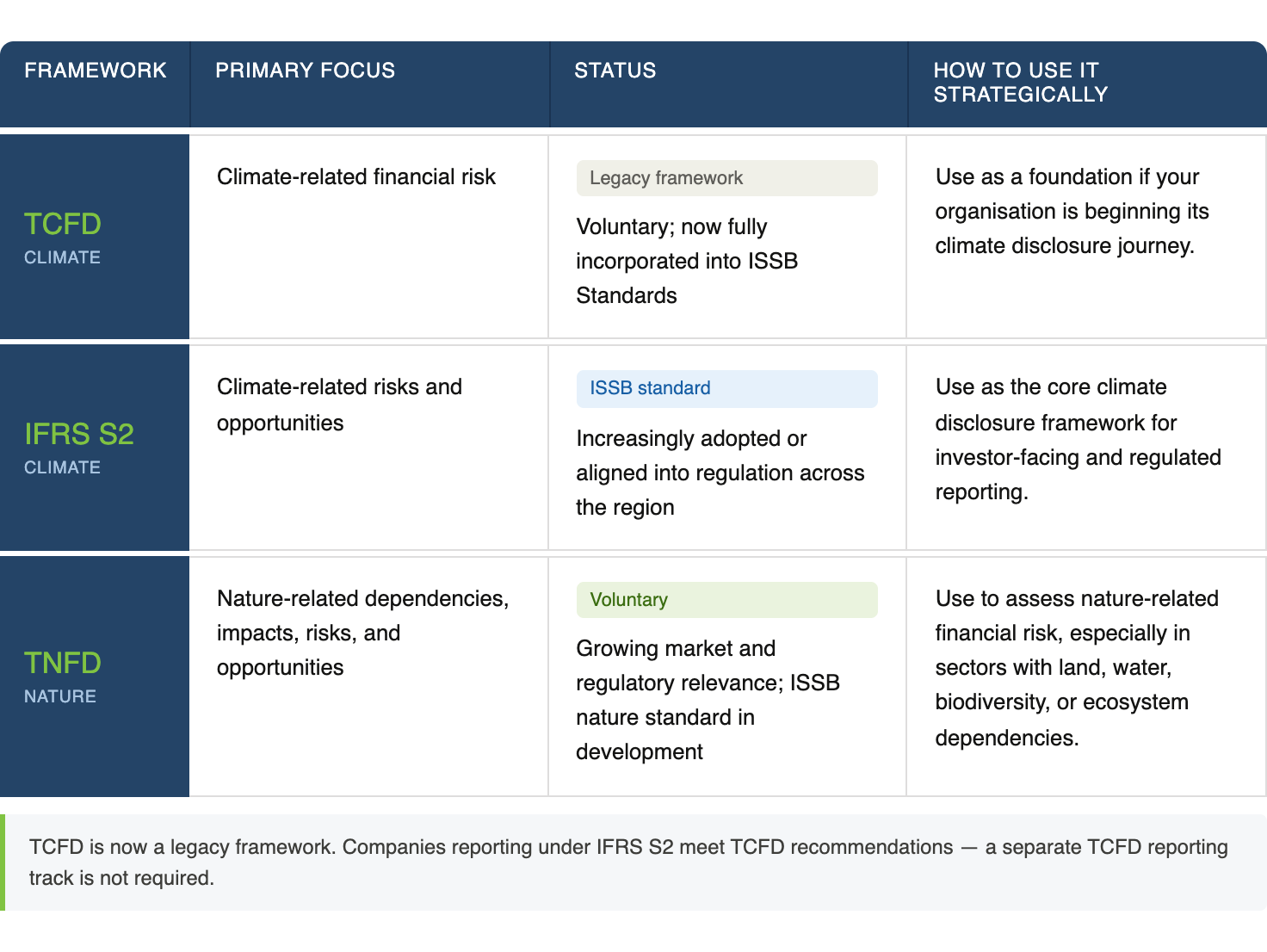
TNFD provides the LEAP assessment framework (Locate, Evaluate, Assess, Prepare) for identifying and measuring nature-related risks. Financial statement integration is not yet required under TNFD, though that is expected to change as the ISSB’s nature standard develops.
How to Decide Which Frameworks Apply
For financial institutions and asset managers, the question is not just about your own reporting obligations. Investors and lenders are increasingly assessing borrowers and investee companies against IFRS S2 and TNFD criteria. Building internal capability to evaluate climate and nature risk across your portfolio is becoming as important as meeting your own disclosure requirements.
For companies in agriculture, forestry, mining, energy, or infrastructure, TNFD disclosures are becoming material regardless of whether they are legally required in your jurisdiction. Supply chain partners, project lenders, and institutional investors are already asking for them. A sustainability consultant with sector and jurisdictional experience can help identify where genuine exposure lies and what level of disclosure is proportionate to your risk profile.
Build Once, Report Multiple Ways
The strategy is simple: collect data once ,structure it to map across frameworks. Avoid parallel processes that consume resources without adding analytical depth.
The regulatory direction across the region is consistent. Around 30 jurisdictions have introduced, or are taking steps to introduce, ISSB Standards into legal or regulatory frameworks. Organisations building reporting architecture around IFRS S1, S2, and TNFD now are making an investment that holds as requirements expand. Those relying on TCFD-only approaches or fragmented reporting will need significant remediation as mandatory requirements broaden.
How ESC Can Help
Our regional presence across Singapore, Malaysia, Indonesia, Hong Kong, Vietnam, and the Philippines means we understand how each jurisdiction is implementing IFRS S2, where nature risk becomes financially material by sector, and what integrated reporting looks like across different business structures and portfolios.
If your organisation is preparing for mandatory sustainability disclosure requirements or looking to strengthen existing frameworks ahead of increasing investor scrutiny, our team is available to discuss.
Visit our Sustainability and Climate Change services page to learn more.